THE HISTORY OF BEACH TENNIS

Beach tennis originated in the coastal town of Ravenna, Italy during the 1970’s. It quickly spread to Brazil and Spain, and then arrived in America in the year 2005. Beach tennis was introduced to the island of Aruba in the year 2000 and has grown rapidly, and currently hosts annual International Beach Tennis Tournaments.

Beach tennis is globally played in Europe, Puerto Rico, Latin America, Australia, USA , Aruba, and Thailand.

Beach tennis was recognized as a sport in 2009 by the International Tennis Federation (ITF) and is now considered to be one of the fastest- growing games in the world. International Tennis Foundation announced the launch of the ITF Beach Tennis Tour in 2008 and a tour calendar has been published every year since. Beach Tennis is being played in over 70 countries world- wide and is continuing to grow with the number of tournaments increasing steadily.

THE BASICS

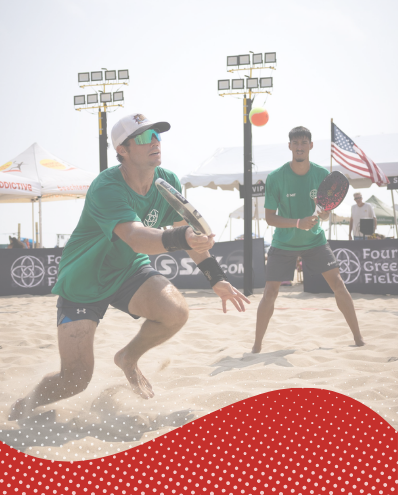
Beach tennis is one of the world’s fastest-growing sports, blending the fast pace of tennis with the fun, social energy of beach volleyball. Best of all, it’s easy to learn and can be played by people of all ages and skill levels.

  • Court Size: Same dimensions as a beach volleyball court (16m x 8m).

  • Net Height: About 5’7” (1.7m) high for both men and women.

  • Equipment: A paddle (solid racquet with no strings) and a low-compression tennis ball.

  • Teams: Usually played in doubles, but singles is possible.

A FEW KEY RULES

No Bounce

  • The ball must be hit directly out of the air — it cannot touch the sand.

Serving

  • Serve from anywhere behind the baseline.
  • In mixed doubles, men must serve underhand, while women may serve either underhand or overhand.

Scoring

  • Games are played to 4 points.
  • If tied at 3–3, the rally is played as a Golden Point (winner of the point wins the game).

Net Rules

  • Players cannot reach their racket over the net during play.
  • Feet must remain on your side of the court — toes cannot cross the net line.
  • If a racket or body touches the net, the point is lost.

3-Meter Rule

  • When returning serve, players must stand behind the 3-meter line until the server makes contact with the ball.
  • After contact, players may move forward.

EASY TO LEARN

  • No racquet sport background required.

  • Played with a slower ball that’s easier to control.

  • Fun, social atmosphere makes it welcoming for beginners.

BENEFITS OF BEACH TENNIS

  • Full-body workout: Builds agility, coordination, and endurance.
  • Joint-friendly: Sand surface is low-impact.
  • Community-focused: A great way to meet new people and join a growing global sport.
  • Play Anywhere: Courts can be set up on sand, grass, or even indoors.